Local developments
Raynes Park High School - Memorial Playing Fields
This following is the Association's submission to Merton's Planning Committe, in response to Planning Application, 26/FULL/0795,
FOR THE CREATION OF A SYNTHETIC TURF PITCH AT MEMORIAL GROUND RAYNES PARK SW20 9LN, INCLUDING FENCING, FLOODLIGHTING, ANCILLARY EQUIPMENT AND ASSOCIATED WORKS.
at: Playing Field, RAYNES PARK SPORTS GROUND, Westway Close, Raynes Park, Merton
The Raynes Park and West Barnes Residents’ Association (RPWBRA) was formed in 1928 in response to concern over flooding in the Raynes Park area at that time, and our monthly magazine now known as "The Guide" first appeared in 1931. We now distribute over three thousand copies of "The Guide" printed every month to cover the present membership.
We have been contacted by many residents in Linkway and Westway Close who are concerned about aspects of this application. Overwhelmingly, they tell us they are going to submit personal objections. We have heard almost no complaints about the current use of the field, either by the schools or by local sports teams.
When previous major work on the field was carried out in 2010, Raynes Park High School (RPHS) held a consultation evening to explain their proposals. In this case, neither Raynes Park High School, nor The Football Foundation, have made any attempt to consult neighbours whose properties overlook the sports field.
It is important to note that our committee believe that it is very important to encourage children and young people to take part in sport for their enjoyment and health. We have no objection with RPHS wishing to improve sporting facilities for its students and those of the neighbouring primary schools but this application’s aspirations are much broader than that.
The Association believes there are serious problems with this application (26/FULL/0795) for a Synthetic Turf Pitch (STP). We therefore hope that the DPAC will reject it, to allow an alternative scheme which would protect local residents and Raynes Park High School’s reputation. There are many grounds for refusing this application:
1)Increased potential for flooding in the locality;
2)Hours of operation
3)Noise disruption
4)Light pollution
5)Ecology of the RPHS Memorial Grounds
6)Parking
7)Impact on athletics
8)Archaeology
1) Flooding and Drainage
i) Drainage and Flooding Strategy:
We note that the Applicant’s Design and Access Statement (Page 13/39) suggests “that the proposed pitch build up & detention basin provide adequate attenuation …”. We note the Applicant has chosen these words carefully to avoid making a firm undertaking that its drainage design would be fit for purpose.
As such, we conclude that the Applicant has doubt that the proposed design drainage design is complete or adequate.
We also note that the Design and Access Statement (Page 13/39) also implies that, as the proposed pitch is within a Flood Zone 3, a 1-in-100 flooding event would cause the whole area to be flooded anyway, and that therefore, in the midst of a flood covering a large area, flows from the site will, somehow, be contained on the site.
We seriously question the logic of this assertion, as it is is plainly not a sensible justification for increasing the impermeability of an existing open space, within a flood zone.
Page 13/39 of the Design and Access Statement also states, “The full drainage design to be installed is outlined in the drainage design document produced and submitted as part of this application.”
However, the only drainage design documents submitted with the Application are:
•A general arrangement drawing on page 80/80 of SEA’s Flood Risk Assessment, and
•A general arrangement drawing for the Cricket Square (Tgms 1238.3-1)
We note that page 80/80 of the Flood Risk Assessment, indicates that the existing ground levels would be changed, such the entire pitch would slope downwards towards the northwest, with a new attenuation pond to be located adjacent to Barnscroft. However, the various notes on the drawing suggest that much of this outline design is subject to further investigations.
We note that Page 12/39 of the Design and Access Statement proposes that all new surface water drainage will be directed into the existing drainage infrastructure, via one or more of the following:
•A new Attenuation Pond north-west corner (i.e. Adjacent to Barnscroft)
•A gully by the existing pavilion, or
•A potential outfall ditch to the northwest boundary, (i.e. Adjacent to Barnscroft and the Bushey Road embankment).
We also note on Page 12/39, the Applicant also states that,
“Whilst the proposed development is designed to be water compatible …, in the case that percolation into the ground or attenuation within the construction is not enough to prevent surface flooding, …”.
We therefore aver that, whilst the Applicant has commissioned a very detailed theoretical flood risk assessment, this does not constitute a complete and robust drainage design. Considering how prone the area is to regular flooding, we aver that the applicant has failed to produce a drainage design that demonstrates that the proposed development will not exacerbate the existing flooding risk.
ii) Local Flooding Risk:
The Applicant appears to have made no attempt to investigate the flooding history of the site and the surrounding area and the frequency with which this occurs.
In the absence of such information, we provide the following information.
The RPWBRA was founded in 1928, and local flooding was a key reason for the Association’s formation. In more recent times, the Environment Agency has designated that significant parts of our area lie on a flood plain. There is, therefore, an ever-present danger of flooding to property.
We note that the Applicant’s submission lacks any reference to the actual observable and regular failure of the local drainage network to cater for the area’s, now-normal, storm water flows.
Our Association’s members have observed flooding in the streets close to the Application Site, as follows:
•Monday, 24 August 2020
•Monday, 12 July 2021
•Sunday, 25 July 2021
•Thursday, 21 October 2021
•Tuesday, 4 January 2022
•Tuesday, 23 June 2026
That is an average of approximately one flooding event every year, not 1 in 10.
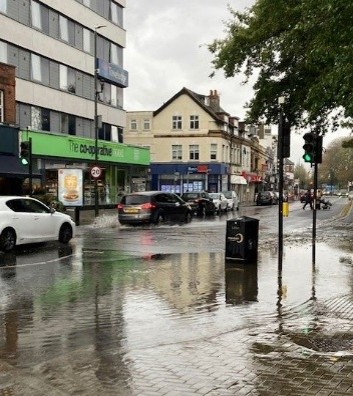
Of course, other areas in the London Borough of Merton (LBM) have had similar experiences on these occasions, but in our area, the following have been flooded: Shannon Corner, Westway, Westway Close, Raynes Park Bridge and Coombe Lane in Raynes Park town centre.

The LBM’s own historic records show several flooding events occurring in Raynes Park, going right back to the early 20th Century. However, with climate change and increased density of development, we observe that such events are becoming much more frequent. Whilst the impact on Raynes Park town centre of these flooding events have been reported in the local press and media, there was less reporting of the other events, occurring in Westway and the adjoining streets.
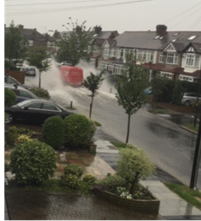
The recent regularity of these flooding events completely discredits any statistical notions of such events being unusual historical occurrences. They are now very much the norm.
iii) Westway and Westway Close adjoining the Application Site:
During these flooding events, the sewers overflow into the street, as evidenced by water spurting up from the manhole covers. It is self-evident that the existing sewers have insufficient capacity to cope with the flows during these, now-normal, events. On these occasions, it caused flooding of the public highways, private gardens, and threatened homes.
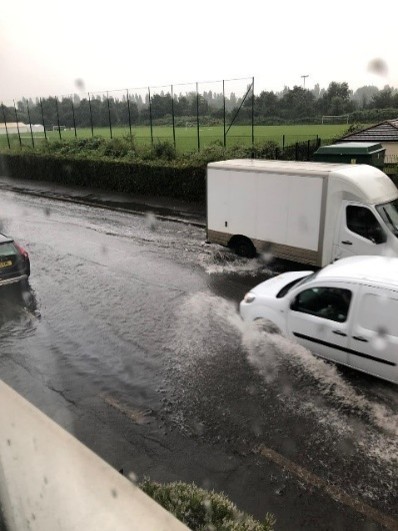
In recent years, there has been a continued loss of permeable surfaces in our area, due to house extensions, the paving over of driveways, infill developments and artificial grass pitches This inevitably results in greater storm water runoff and greater discharges into the existing drainage infrastructure. This all makes overflows more likely.
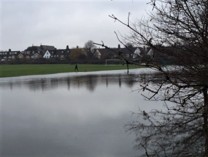
The Application site has an ever-present risk of flooding from storms, which frequently fill the existing sewers to capacity, such that they cannot cope and overflow into the streets.
With the effects of climate change, the loss of permeable areas and increasing density of development, this problem will continue to become even more common and more severe.
iv) Flood Risk Management Authorities:
LBM’s partners in Flood Risk Management are Thames Water (TW) and the Environment Agency (EA). We have concerns with our recent experience with these two organisations.
Firstly, Thames Water has an obvious conflict of interest because of the attractiveness of new developments adding to its future revenues, which may lead to it playing down the demonstrable inadequacies of its drainage infrastructure and the resulting increasing flood risk.
Secondly, the EA classifies the Pyl Brook as a main river and as a potential source flooding in the Westway area. However, it seems that the EA is uncertain of the exact route of the culverted section between Kings College Playing Field and the level crossing at the West Barnes Lane/Burlington Road junction. The EA sent a speculative letter to residents regarding their possible riparian responsibilities, without verifying the exact course of the culvert. These conflicts of interest and lack of information only make matters worse.
We aver that the Applicant does not have a complete and detailed drainage design and has not taken into account the recent history of flooding in the vicinity.
We therefore recommend that the proposal to increase the impermeability of the existing site, which is located on the Flood Plain, should be rejected.
2) Hours of operation:
The potential to have matches and training every day on the STP from 8am to 10pm is naturally of great concern to neighbours. It is proposed that these times would apply every day of the year. There will therefore never be a time when residents can enjoy peace and quiet in their gardens without the intrusive noise of balls hitting the chain link fence, shouting and, for most of the time, whistles – see section 3).
We believe this constitutes a serious encroachment on residents’ privacy, leading to increased stress levels. We therefore recommend that there should be a condition that there will be no play in the STP from midday on either the Saturday or Sunday every week. This would allow residents to plan get-togethers of friends and family without the disruption caused by noise or lighting. This condition need not affect the use of the rest of the field, e.g. by cricket clubs.
A 9pm closure of the STP on weekdays would be more acceptable to most residents, with a switch-off time of 8.30 for the floodlights. If clubs wish to play or train later on a STP, they should use the artificial pitches on the school’s main site.
When asked about these hours of operation, our Secretary was told that 10pm was the cut-off time for lighting at Raynes Park Vale Football Club (RPVFC) justified this time. However, the nearest houses on Grand Drive are further from the RPVFC pitch and are screened by an area of woodland and/or the garages from Cannon Close. This can easily be seen using Googleview, so the comparison is misleading.
3) Noise disruption to neighbours:
The NIA rightly identifies the need for a noise reduction fence to protect Barnscroft residents. However, Linkway and Westway Close residents will also be impacted by noise when the proposed STP is in use.
Tables 2 and 6 of the NIA give the WHO noise criteria and typical sound levels for various activities, such as 8-a-side training match. Comparison of these tables shows that the sound levels of the STP are likely to exceed the WHO criteria for Linkway and Westway Close residents, despite what is shown in figure 9. The type of noise is also important. The impact of balls frequently hitting the 4.5m surrounding metal fences, even with their neoprene isolators, will be very stressful and prevent residents enjoying their gardens or having open windows. It is also likely to impact those working from home and getting children to sleep. This is recognised in paragraph 8.8 of the NIA:
“With the required barrier, the highest predicted maximum noise levels from the highest individual source location at the window of the façade of the worst case NSR to the west is 63 dB(A), and at the NSR to south is 57 dB(A).”
63dB(A) and 57dB(A) both exceed the WHO “moderate annoyance, daytime and evening” level (50dB) and “serious annoyance, daytime and evening” (55dB)
How often will balls hit the fence to produce the “worst case” levels of noise? It could be many times each minute and is thus an unacceptable intrusion into neighbours’ lives, leading to increased stress levels.
Figure 5 shows where the noise impact modelling was carried out at Coombe Dingle Sports Complex in Bristol. As can be seen, the pitches at Coombe dingle are not surrounded by housing, as is the case at RPHS’s Memorial Ground. Houses in Westway Close and Linkway will reflect sound waves, this increasing the noise levels thus invalidating the noise predictions shown in Figures 9 and 11.
Players and coaches shouting is part and parcel of both practices and matches. Even if the noise levels are as predicted in paragraph 8.6, they would still disrupt neighbours’ privacy.
The NIA clearly states that noise from whistles will be too loud (worst case NSR to the west is 68 dB(A), and at the NSR to south is 65 dB(A) - para 8.7) but the solution is laughable, para 9: “no whistles after 6pm” seems sensible but is then followed by “with whistles only permitted during competitive matches”. A more sensible arrangement would be to prohibit competitive matches after 7.30pm. School matches would therefore be unlikely to be impacted.
The RPWBRA believe that this application should not be granted until more suitable modelling is carried out.
4) Light pollution:
Residents are concerned about the following statement in the DAS (page 17/40):
“LED floodlighting was chosen[…] to facilitate economical / ecological management and prevent ‘over lighting’ to pitch areas when not in use.”
Surely, when the pitch is not in use, all floodlights should be switched off.
Despite the information produced by Signify Uk’s Lighting Application Specialist (LiAS) team and the DAS, local residents have told the RPWBRA of their concerns about floodlighting so close to their gardens, potentially to 10pm every night. We suggest a compromise be found with the lights switched off at 8.30pm and the site closed from 9pm every night, except for either Saturday or Sunday, when the STP should not be used after midday [see 2) Hours of operation].
5) Preliminary Ecological Appraisal:
Residents living in Westway Close and Linkway have rightly described the Preliminary Ecological Assessment as a joke. The RPHS Memorial Ground’s ecology needs to be considered as a whole, not focusing almost entirely on the proposed location of the STP. To give two examples:
i)The ecologists did not see the flock of 60 or so gulls which feed and rest every day throughout the early morning. The flock includes red and amber-listed species: herring, lesser black-backed and black-headed gulls. The reduction on grassland will negatively impact their feeding.
ii)No attempt has been made to list species that use the field and its tree-line: common and soprano pipistrelles, hedgehogs, frogs, toads, house sparrows, dunnock, greenfinch etc… to mention just a few. Residents can provide a full listing. It is likely that the increased noise from a STP would reduce the numbers of birds successfully nesting in this area.
The PEA suggests ways to improve the site’s biodiversity, e.g. wildflower meadow planting and a sparrow nesting box on the pavilion. The RPWBRA agrees with residents that bat and bird boxes could be put in all the mature trees; “bug hotels” near any wildflower planting; and log piles to provide habitat for stag beetles which are regularly found in this area.
6) Parking
The DAS statement “STP parking demands” (page 33/40) states that no extra parking should be allowed on the site, pointing to the negative impact of allowing cars to park on the grass – this is to be commended.
While the local community home teams will probably walk or cycle to the sports ground, members of visiting teams are more likely to come by car. Parking for all visiting cars must be on the Raynes Park High School site; the statement “Additional parking potential at Raynes Park High School. is too vague. Residents were told this would be the policy when the sports field was developed in 2010, but gradually more and more people park in neighbouring streets to reduce their walking time.
The impact of cars owned by residents of Sterling Place has not been taken into consideration: the development has only 220 spaces for 456 apartments. It is likely that some Sterling Place residents will park in Westway Close and Linkway.
A condition of granting this application should be that all parking has to be on the RPHS site.
7) Impact on Athletics:
According to the DAS,
“prior engagement was undertaken with England Athletics to ensure that following development, the proposals would meet their aspirations for continued cricket on the site.”
We assume that the mention of “cricket” is a typo. There is no documentation, however, from England Athletics on the Regulatory Services Hub which seems odd. Please may there be greater transparency.
8) Archaeology:
As Historic England has identified in their comment (71578471782815848_-_26FULL0795-Comments-Historic_260705_073327.pdf) that a desk-based assessment is insufficient. If this application were to be granted, the condition suggested by Historic England must be included in the decision.
Conclusion:
In its current form, we believe that 26/FULL/0795 should be rejected by the DPAC. While some of the issues highlighted in this comment could be addressed by conditions, overall, there are too many serious problems which need to be resolved:
•Flooding and drainage: the theoretical RAs and strategy are based on inaccurate data.
•Hours of operation, noise and lighting: impact on residents’ right to some privacy, peace and quiet. However, the details of this proposal go far beyond any benefits to the students at RPHS, Sacred Heart and West Wimbledon primary schools.
•Ecology: the PEA underestimates the ecological importance of the STP site in the wider field. There is great potential to improve biodiversity – an educational opportunity for RPHS students.
•Parking: all players’ cars need to park at Raynes Park High School.
•Archaeology: fieldwork is needed – another educational opportunity.
We urge the DPAC to reject this application.
Submitted on behalf of Raynes Park and West Barnes Residents’ Association
Jerry Cuthbert and Mary-Jane Jeanes
28/07/2026
